
Personal Iceberg
Duration: 60 days
Based on what answer you wrote we will decode your anger iceberg by the help of personal iceberg.
Take the printout of the Personal Iceberg. Fill in the blanks.
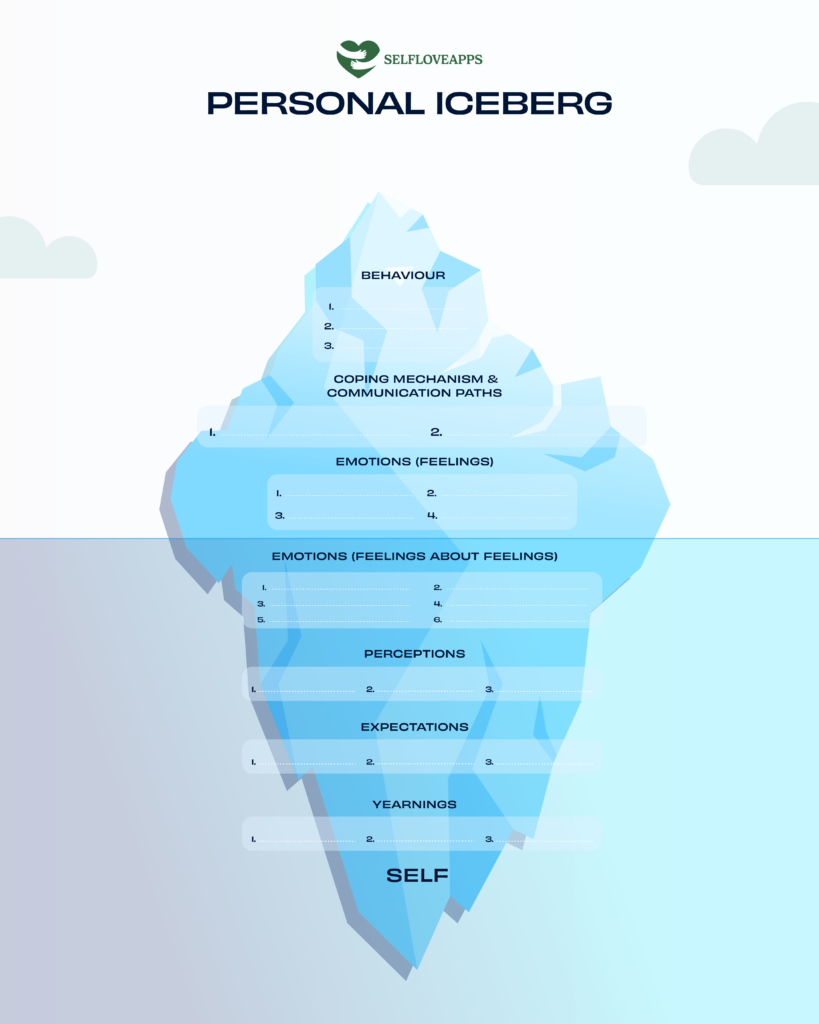
(Take your time this exercise needs at least 7 to 10 days. Try to focus only on one layer of the focus and do not proceed to the next layer until you learned from the first layer)
Take your own time. You might need a weeks’ time to understand each different level (A to F) of the personal iceberg. Devote at least a day to each level. This exercise in the long term will be very helpful to understand how surface level behavior is related to so many different levels of conscious and subconsciousness reaching the core of “SELF”.
- The outer behavior: This is the surface level actions which are seen by others or in other words, what others see in you because of your own actions. Think of a recent behavior of yours which you did because of being angry.
Based on your recent particular behavior (example when you were recently angry, sad, excited, disgusted) which you want to analyze, write the following answers to the questions:
- How has my behavior affected other people?
- How did other people around me react?
- How did my and their behavior trigger each other?
- Your defense mechanism: Defense mechanism is an unconscious psychological strategy used to cope with stress, anxiety, or difficult emotions. These automatic mental processes protect you from distress, though they can be either beneficial by helping navigate painful experiences or maladaptive if they are rigid or overused.
Following are defense mechanism often used us several of us in day to day social interaction, try to analyze which one you use often to protect yourself:
- Denial: Refusing to accept uncomfortable facts or feelings. For example, ignoring evidence of a problem in a conversation and acting as if everything is fine.
- Projection: Attributing one’s own unacceptable emotions or thoughts onto others. For example, accusing someone else of being angry or hostile when those feelings are actually one’s own.
- Rationalization: Creating logical but false explanations to justify behavior or feelings to avoid the real reasons. For example, explaining away a mistake by blaming external circumstances.
- Reaction Formation: Acting in a way opposite to true feelings to hide them. For instance, being overly polite to someone one actually dislikes.
- Displacement: Redirecting emotions from the original source to a safer target, such as expressing frustration with a coworker by snapping at a family member.
- Repression: Subconsciously blocking painful or anxiety-provoking memories or thoughts, leading to difficulty discussing certain topics.
- Regression: Reverting to childlike behaviors or attitudes when stressed, such as sulking or whining during disagreements.
- Humor: Using jokes or sarcasm to deflect tension or anxiety in conversations.
- Suppression: Consciously pushing uncomfortable thoughts or feelings out of awareness temporarily during a discussion.
Based on your analysis answer the following questions:
- How is my defense mechanism helping me in the long term?
- If yes, how am I using the same for my advantage without creating misunderstanding for others? Is there any time it has created misunderstanding? What have I learned from that?
- If not, how are the ways my defense mechanism has created misunderstanding for others? What can I do better?
- How are my defense mechanisms related to my communication pattern as earlier explained different communication stances in exercise 7?
- Understanding Primary and Secondary emotions:
Now let’s get back to the emotional wheel in exercise 3. Please pay attention to the outer ring of the emotional wheel; those are Secondary emotions and how they are related to the core or Primary emotions.
Secondary emotions such as anxious, mad, ashamed, curious, or excited are the nuanced feelings people often express or display on the surface during daily interactions. These are more specific and socially recognizable than the core emotions, but they actually stem from deeper, primary emotions at the wheel’s center.
For example:
Anxious, Scared, Powerless in the outer ring are linked to the primary emotion of fear, expressing its different shades that may be easier to communicate or notice.
Irritated, Mad, Hateful, Insecure are surface expressions commonly visible in behavior, but they usually trace back to the primary emotion of anger, even when anger itself is not directly named.
- Ashamed, Apathetic, Despair, Guilt can present themselves in mood or language, all rooted in the primary emotion of sadness.
- Curious, Proud, Optimistic, Joyful are pleasant surface feelings belonging to the core emotion of happiness.
- Excitement, Shock, Confusion, Awe display outward surprise, each mapping back to the primary emotion of surprise.
- Disapproval, Disappointed, Awful, Aversion outwardly present as subtle reactions, but their root lies in the core feeling of disgust.
Now based on your understanding:
Write down your feelings/ emotions at the surface level
Then write down your feelings behind surface level feelings/emotions, these are your core emotions. Often these emotions are hidden and the people around you may not be knowing your core primary emotions.
Let’s explain this with a real-life scenario of a couple (Robert and Daisy) and their misunderstanding:
Robert and Daisy have been in a romantic relationship for a few years. Daisy often complains that Robert withdraws and never expresses his emotions which Daisy craves for, the push and pull in their relationship often creates tension leading to frustration and disappointment. Daisy thinks Robert is too cold and withdrawn and might have lost his interest in love with her. Robert’s actual reason for coldness is stemming from insecurity of he is not good enough and feelings that whether he is unwanted by Daisy who often complains that he is not expressive.
In Robert’s situation, the outward patterns and the emotions expressed in his romantic relationship are classic examples of how secondary emotions and coping strategies can mask vulnerable primary emotions.
What Daisy See: Secondary Emotions
On the surface, Robert appears cold, withdrawn, and unexpressive. These are secondary emotions or behaviors that people often witness and may interpret as indifference, detachment, or even resentment. Secondary emotions are shaped by learned responses, social influences, and attempts to protect oneself from pain; they are less vulnerable and more defensive, making them easier to show but harder to connect with emotionally.
What Robert Feels Inside: Primary Emotions
Beneath this surface, Robert’s true, primary emotion is fear, more specifically, the fear of not being good enough and the fear of being unwanted or rejected by his girlfriend. These emotions may also be mixed with sadness or shame about not being able to give his partner what she wants emotionally or not feeling lovable as he is.
How Secondary Emotions Develop from Primary Emotions
Robert finds his core feelings of fear overwhelming or difficult to manage, he unconsciously adopts withdrawal and emotional “coldness” as coping strategies, secondary emotions and defense mechanisms that protect him from vulnerability. Instead of expressing his underlying fear, he defaults to a quieter, more shut-down presentation, which paradoxically creates more distance in the relationship. Unfortunately, Daisy sees only the surface (coldness), not the real root (insecurity/fear).
After understanding this above case scenario.
Write down the following questions:
- What are your primary emotions that create misunderstanding for others?
- How expressing your core emotions will be helpful to resolve the misunderstanding?
- How comfortable are you with expressing your core feelings? Give yourself grace, we are trying to unlearn unconscious defenses for which you need tools, take time to develop new coping mechanisms.
Few useful Coping mechanisms:
Coping mechanisms help people regulate emotions, communicate effectively, and maintain emotional balance in everyday interactions.
- Deep Breathing: Taking slow, deep breaths to calm nervousness or anger during difficult conversations.
- Positive Self-Talk: Using encouraging or reassuring inner dialogue to maintain confidence and reduce anxiety.
- Humor: Lightening tense situations by making jokes or finding humor to defuse stress and create rapport.
- Active Listening: Focusing fully on the other person’s words to feel understood and reduce misunderstandings.
- Avoidance: Sometimes people avoid certain topics or interactions temporarily to protect themselves from emotional overwhelm.
- Seeking Support: Turning to friends, family, or colleagues for advice, validation, empathy or therapy when stressed.
- Reframing: Changing the way a problem or comment is viewed to see challenges as opportunities or less threatening.
- Setting Boundaries: Politely saying no or steering conversations away from topics that cause distress or discomfort.
- Distraction: Redirecting attention to neutral or pleasant topics when emotions run high during communication.
- Physical Movement: Using gestures, pacing, or subtle movements to release built-up tension in social or verbal exchanges.
- Perceptions:
A person’s perceptions are deeply shaped by their own belief systems, assumptions, generalizations, values, and subjective realities, creating a unique personal “world” through which they interpret everything. This internal lens acts as a filter that colors how a person sees themselves, others, and all external events.
Beliefs whether about oneself, others, or life in general serve as the foundation for perception. For example, if someone believes that people are generally trustworthy, they will tend to notice kindness and goodwill in their interactions. Conversely, if someone assumes people are unkind or threatening, their perception will highlight suspicious or negative behaviors in others. These beliefs are often formed through past experiences, culture, and upbringing.
Because perceptions are based on subjective filters, two people can see the same situation very differently. What you notice, how you interpret it, and what meaning you assign is influenced by your mental models and values. This creates personal realities that feel completely genuine yet they are not objective truths but constructed interpretations.
Also, once a belief is formed, the brain tends to seek confirmation and disregard conflicting information (confirmation bias), reinforcing these personal worlds. This is why assumptions and generalizations can be hard to change, and why misunderstandings and interpersonal conflicts often arise—they stem from different, ingrained ways of perceiving reality.
In essence, each person lives in their own perceptual reality shaped by their beliefs, values, and experiences, and they naturally view others through these colored lenses. Recognizing this helps foster empathy, curiosity, and openness to alternative viewpoints, which can expand understanding beyond one’s own subjective reality.
This process helps you understand the followings:
- Beliefs and values create mental filters shaping attention and interpretation.
- Subjective perceptions create individualized realities, distinct from objective facts.
- Perception influences behavior and relationships since people respond to their realities.
- Awareness of this process offers opportunities for self-reflection, growth, and improved connections with others.
In this exercise you are going to choose your own values. Write down at least 5 important values which align with your core principles.
Following are few list of human values which might be helpful:
Here is a list of values that commonly guides one’s behavior, decisions, and relationships:
| Accountability | Cooperation | Fairness | Individuality | Patience |
| Adaptability | Courage | Flexibility | Innovation | Perseverance |
| Altruism | Creativity | Freedom | Integrity | Respect |
| Ambition | Curiosity | Generosity | Justice | Responsibility |
| Appreciation | Determination | Gratitude | Kindness | Resilience |
| Authenticity | Diligence | Growth | Leadership | Self-control |
| Balance | Discipline | Harmony | Learning | Service |
| Boldness | Empathy | Honesty | Loyalty | Sincerity |
| Compassion | Equality | Humility | Mindfulness | Spirituality |
| Commitment | Excellence | Independence | Optimism | Trust |
| Truthfulness | Understanding | Wisdom | Zeal | Generosity |
Now, take your time to reflect on your values, understand that perceptions are not absolute but personally constructed, often they are related to your own values, however others can have a different value system than yours.
Pro Tip: You can cultivate greater flexibility and compassion by understanding self-values and self-perceptions built on your own values and holding space for others perceptions based on their values. This is a great tool to de-escalate any communication challenge between two or more persons.
- Expectations and Yearnings:
People often set expectations for others based on their own beliefs, values, and personal yearnings such as the need to be loved, accepted, purposeful, meaningful, or freedom without knowing or considering what the other person actually expects or feels. These expectations are often unexpressed assumptions rather than openly communicated desires, which means they exist mostly in the person’s subjective reality.
Let’s discuss a real-life scenario of Leah, an ambitious accountant who yearns for recognition at the office and her husband Bryant, an insurance agent, who yearns for appreciation and expressive love from her wife who he feels is always busy at work.
For the couple Leah and Bryant, the core issue arises from unspoken and differing expectations fueled by personal yearnings that are not openly communicated. Leah’s ambition and desire for professional recognition drive her focus on work, a value deeply meaningful to her, but she hasn’t shared this motivation with Bryant. Meanwhile, Bryant yearns for expressive love and appreciation, a need shaped by previous relationships, but his wife’s silent priority on work leaves him feeling neglected and frustrated.
As because Leah and Bryant have not articulated their core needs and expectations, they experience misunderstanding and conflict. Leah assumes Bryant understands the importance of her work and the reason for her apparent emotional distance, while Bryant expects more visible affection and reassurance based on his own emotional style. Both have subjective realities shaped by internal beliefs and unmet emotional needs for love, appreciation, meaning, and connection.
This lack of open communication creates a gap where personal assumptions remain unchecked, leading to disappointment on both sides. Their unmet expectations provoke emotional upheaval Leah may feel pressured or guilty, and Bryant may feel unloved or rejected. Had Leah shared her yearning for recognition and the meaning she derives from work, and Bryant expressed his need for affection and verbal appreciation, they could have aligned their expectations and found more compassionate ways to support each other.
Based on your understanding from the above real-life scenario, answer the following questions:
Personal yearnings such as to be loved, appreciated, and purposeful shape expectations.
- List a few scenarios where without communication, assumptions about others’ understanding you created expectation gaps.
- At present what are your unmet needs which lead to frustration, emotional distance, and arguments.
- What can happen if you open dialogue about your motivations, emotional needs fostering understanding.
- Do you feel that aligning your own expectations through empathy and communication will reduce conflict and deepen connection? What is holding you back to give a try to do the same?
- Understanding Self:
A person who deeply understands their core self-including their needs, wants, choices, values, communication style, principles, and life objectives builds a foundation of self-sufficiency on emotional, mental, and physical levels. This profound self-awareness leads to congruency between what they desire and how they live.
By clearly recognizing and owning their internal drivers, they make intentional choices aligned with authentic values rather than external pressures or expectations. This alignment cultivates inner harmony and reduces conflict between desires and actions.
Such a person practices emotional self-sufficiency, meaning they identify, regulate, and fulfill their emotional needs without over-dependence on others. Mentally, they maintain clarity of thought and resilience by observing their thought patterns and adapting constructively. Physically, they prioritize health and well-being as a vital resource to sustain their overall balance.
Over time, this integrated self-knowledge allows the person to discover and clarify their mental, emotional, and physical aspirations authentically. At a deeper stage, they may hear and align with a spiritual calling or sense of purpose, which completes a holistic sense of congruency.
This journey combines self-discovery (understanding one’s past, core beliefs, and patterns) and self-creation (actively shaping one’s present and future) to become a fully integrated, congruent person. The outcome is living a life imbued with intentionality, integrity, meaning, and alignment across all dimensions of being.
Activity
The Personal Iceberg helps you understand how visible behaviors are shaped by hidden emotions, defenses, beliefs, values, and unmet needs. This prolonged exercise gently guides you from surface reactions to deep self-understanding and emotional congruency.
Purpose of the Exercise To understand the root causes behind emotional reactions, especially anger To identify unconscious defense mechanisms and coping patterns To differentiate surface emotions from core primary emotions To recognize how beliefs, values, and perceptions shape relationships To build emotional self-awareness, congruency, and healthier communication